Wednesday, June 10, 2015

Fourth of July Holiday

UMMS HR recently sent a memo about the Fourth of July holiday which said that "the University of Massachusetts Medical School will be officially open for business on Friday, July 3, 2015 and Monday, July 6, 2015." This has caused some confusion, since most SHARE members were expecting to have Friday, July 3 off, because that is the way that Saturday holidays have been handled in the past.

We reached out to HR to clarify, and have two reassuring messages to relay:

  1. No one is losing out on getting a holiday, although some UMMS departments may need some staffing on Friday.
  2. HR will send out a clarification, this week we hope, about which departments will need skeleton staffing and which can be closed on July 3.

Thursday, May 28, 2015

EAP & Thought for the Day

“Don't let what you can't do stop you from doing what you can do.”  -John Wooden

Quotes like this one can land in your inbox on a weekly basis, along with a short motivational message. To get yourself some regular inspiration, simply sign up for the free "Thought of the Day" email on the Employee Assistance Program webpage.

We can't mention the Thought of the Day here without putting in a good word for the Employee Assistance Program itself. We consistently hear that the EAP counselors are thoughtful, wise, and helpful. And the SHARE organizing staff knows from personal experience that the EAP staff offers important support and guidance, regarding both workplace and personal issues, for employees of the UMass community. 

About the EAPThe UMass Employee Assistance Program (EAP) is a workplace-based program providing consultation, assessment, intervention, information and referral for employees and their household members. The EAP offers personal assistance to address a variety of issues, including individual, family and work-related concerns. The EAP is free and confidential  to the full extent of the law.  Employees and household members can obtain assessment, short-term problem-focused intervention, and referral and information for treatment or other assistance.We are conveniently located in Worcester, MA and serve all of Central Massachusetts.

Sunday, April 5, 2015

SHARE Opposes Proposed GIC Health Insurance Increases

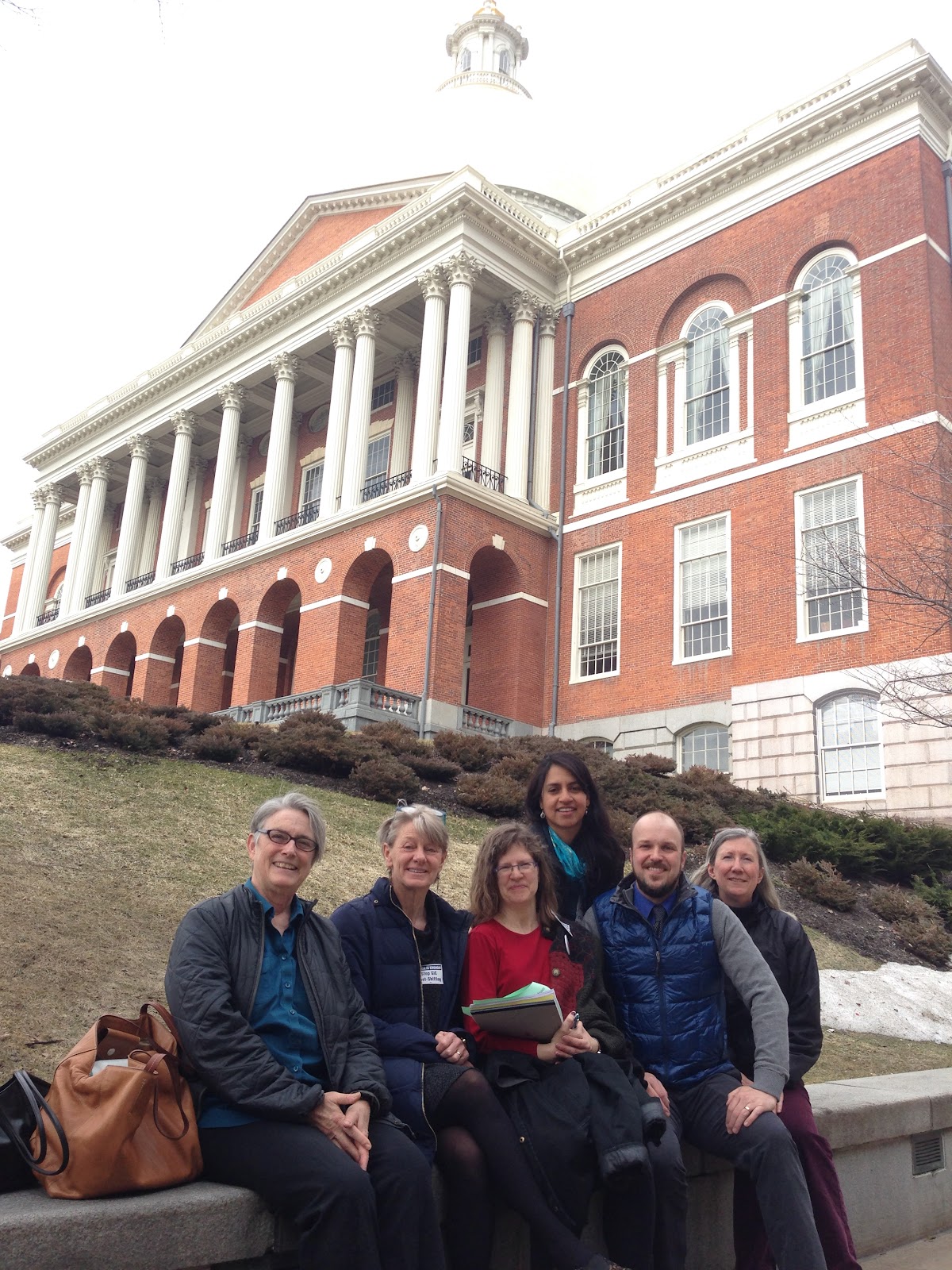
It’s not often that SHARE heads up Beacon Hill to knock on the doors of elected officials. However, Governor Baker’s House 1 FY2016 Budget Recommendation includes a change in the GIC Health Insurance plans to increase employee contributions from 20% to 25%, regardless of date of hire. In response, SHARE Representatives came to the State House as part of an AFL-CIO Union Lobby Day to educate legislators about this proposal, and ask them to oppose it.


IMG_1698.JPGUnion members and representatives came from across Massachusetts to participate. We footed up and around the labyrinthine halls to meet with legislators representing Central Massachusetts and many of their senior staffers. Along the way, we met other union representatives from Central Massachusetts, including women from the Court system and the Mass DOT. (In one particular meeting-- where I happened to be the only man present--the others happily joked “Did you ever think you’d see the day when unions were 95% women?”) We traveled with these other groups to some of the legislators’ offices together, carrying our common interests. One woman explained that, since a procedure two years ago for chronic illness, she would have to regularly take six medications for the rest of her life; she calculates that Baker’s Budget Recommendation would cost her an additional $150 per month, just for these medications.


The change would significantly increase out-of-pocket costs for all State employees, some of whom already ration essential treatment due to cost. Coupled with premium rates that will increase by as much as 9%, this change would cost many families as much as $1,500 next year. On top of that, the GIC has already approved increases to employee co-pays and deductibles that will further increase out-of-pocket costs. Taken together, these changes represent $160 million of increased costs for employees next year.


One particular highlight was our visit with Senate Majority Leader Harriet Chandler, who invited us into her office, and spoke with us thoughtfully about the issue. She pointed out to us that her roles in the State government over the years have provided her a particularly informed understanding of healthcare and insurance issues in Massachusetts, and explained that we had nonetheless provided her with new insights, while graciously thanking us for information that would be useful to her voting decisions.


We can expect more cost-shifting to public employees to come under the current administration. You can participate by encouraging your local legislators to oppose the Governor’s current budget proposal. You can find the leaders of local cities and towns online. Tell them the story of what the change would mean for you and your family. Below you’ll find more details you can pass along.


  • A proposal in Governor Baker’s FY 2016 budget recommendation seeks to raise the share of health insurance premiums paid by many state workers by 25 percent.
  • Roughly 45,000 workers would go from an employer/employee premium split of 80/20 to 75/25.
  • If implemented, the cost of a family health insurance plan through the Group Insurance Commission (GIC) would increase by as much as $1,500 next year.
  • This change represents a cost-shift of $34 million onto state workers.
  • Our out-of-pocket costs are already going up next year through increases to employee co-pays and deductibles, and higher annual premiums that the GIC has already approved.
  • The average premium for a GIC health plan will increase by 5.7% next year, with some increasing by as much as 9%
  • In total, these changes represent $160 million in increased costs on state workers in FY 2016.
  • The state has already achieved significant savings by increasing co-pays and deductibles paid by workers.
  • Rather than raise costs on workers even further, the AFL/CIO advocates that some of these savings should be used to lower premium contribution for employees hired after 2003 who are currently paying 25 percent, and equalizing all state employees at a 20 percent premium contribution.


Friday, March 13, 2015

College Scholarship Opportunity: Central Massachusetts AFL/CIO

The SHARE office recently received the following notice in the mail from Joe Carlson, the President of the Central Massachusetts AFL/CIO, about a really great scholarship opportunity for our members. The lottery for these scholarships will be open to any SHARE members, as well as children and grandchildren of our members, who will graduate from high school this year and attend college next year. The details are posted below. Please note that applications should NOT be sent to the SHARE office. If you would like a copy of the nomination form, please click here

***

To: All Affiliated Locals of the Central Mass AFL/CIO,

We are pleased to announce that we will be awarding six $1,000.00 scholarships as well as a number of  $500 Platinum sponsored scholarships.

The scholarship recipients will be drawn by lottery at the May community services committee meeting and the winners will be announced at the Annual Scholarship Golf Tournament on Friday, June 5, 2015.

The scholarships will be presented at the Labor Day breakfast September 7 2015

To be eligible, the student must be a 2015 graduating high school senior and going on to college, and a child, grandchild, or member whose local is affiliated with the Central Ma. AFL/CIO. Union members must live or work in the jurisdiction of the Central Ma. AFL/CIO.

All names must be submitted by May 1, 2015 and returned to:


Paul Soucy
AFL/CIO Labor Community Services
Central Ma. AFL-CIO
400 Washington St
Auburn, Ma. 01501


Fraternally Yours,
Joseph P. Carlson, President
Central Massachusetts AFL/CIO

Wednesday, March 4, 2015

SHARE Voices: When to Pick Workplace Battles

In this SHARE Blog Review, Union co-president Sherry Nguyen describes a useful article for weighing options in dispute resolution. As a SHARE member you can also use our Problem Solving processes, as well as receive support from SHARE representatives. Please contact the SHARE office for help.

And, if you would like to submit an idea, a request, or a submission for publication on the SHARE UMMS blog, please email your thoughts to kirk.davis@theshareunion.org

***

When to Pick Workplace Battles

Submitted by Sherry Nguyen

A few weeks ago I read an informative article in the Wall Street Journal by Sue Shellenbarger, and I’d like to share some of the key points with you.  We’ve all experienced tensions in workplace, whether with coworkers or superiors.  The question is what to do about it.  Although most people try to avoid conflict, this is neither the most productive nor healthiest route.  Avoidance can create more useless tension that has a negative effect on productivity and creates unhealthy stress levels.

So what can be done?  In the article, “To Fight or Not to Fight? When to Pick Workplace Battles,” Shellenbarger emphasizes that the best action depends on the situation.  There are definitely some situations where waging war would be a losing battle and retreat is the most prudent action. Some of these situations include:

  • Picking fights over issues that are not relevant to your work or outside of your area(s) of responsibility
  • Battling over trivial issues based on personality or power
  • Waging war without offering solutions or suggestions
(Read the article at http://www.wsj.com/articles/picking-your-workplace-battles-1418772621 for more situations and details.)

Along with these suggestions as when not to do battle, the article offered winning strategies when you do decide that confronting the situation is the best way to proceed. These winning strategies include planning ahead, talking with your colleagues, and knowing when it is appropriate to disagree.     I highly recommend you read more (link) about these winning strategies.

Conflicts are a fact of life.  While it can be risky to speak up – hurt feelings, a damaged career -- not speaking up, especially if the annoyance is shared by others, can result in simmering frustrations which can lead to passive aggressive behaviors such as slacking off and backstabbing.  While learning when to pick a battle is an art worth learning, you have the benefit of SHARE staff who has the experience to help you through it, either with you in meetings with your supervisor or behind the scenes as a coach


The article “To Fight or Not to Fight? When to Pick Workplace Battles” was written by Sue Shellenbarger, and appeared in the Wall Street Journal on 12/16/14.

Wednesday, January 21, 2015

UPDATE: Change in Overtime Policy


The negotiated change to the Overtime Policy will be reflected in the next paycheck (the one issued January 30, for this week and last week's work.) SHARE recently received this revised implementation date from Human Resources, which comes sooner than reported in a previous blog post.

These changes will not affect SHARE members in Animal Medicine, Psych Continuing Care Units, and Public Safety.

In the most recent SHARE-UMMS contract negotiations, the Medical School management team approached our union with the intent to reduce the Overtime paid to SHARE members. The SHARE negotiating team contended that many members rely on OT as an essential part of their wages. And, because some departments use OT as an inherent part of their staffing model, or sometimes mandate employees to work OT in order to get urgent work done, maintaining the OT pay standards would be particularly important there.

After research and discussion, we reached an agreement with the employer that makes some changes to the policy, but which works to protect those core concerns. The new policy, as it appears in the current SHARE contract, is copied below.


Overtime

Monday-Friday, day-shift-only departments:

Employees in these departments shall be compensated at the rate of time and one-half their regular rate of pay for authorized overtime work performed in excess of forty (40) hours per week. Effective 1/1/2015, if sick leave, vacation time, holiday compensatory time or personal time is used in the same work week, it shall not be considered as time worked for the purposes of calculating overtime compensation. Holidays shall be considered time worked for the purpose of calculating overtime compensation. It is the intention of the parties that employees in these departments should not generally be forced to work overtime. If a particular department requires the use of forced overtime, the parties will meet to discuss the matter.

Departments with weekend shifts, evening shifts or night shifts:

Employees in these departments shall be compensated at the rate of time and one-half their regular rate of pay for authorized overtime work performed in excess of forty (40) hours per week. For employees in these departments, holidays, vacation time, holiday compensatory time and personal time shall continue to be considered time worked for the purpose of calculating overtime compensation. Sick time shall not be considered time worked for the purpose of calculating overtime compensation. Employees in these departments shall continue to be compensated at the rate of time and one-half their regular rate of pay for authorized overtime work performed in excess of their regularly scheduled shift, as long as that shift is at least 8 hours.

These departments are: Animal Medicine, Psych Continuing Care Units, and Public Safety.

Review of effect of overtime rules:

UMMS and SHARE will convene a joint committee to study the effect of this Overtime article on departments and employees, in both kinds of departments. If there are concerns on either side, the parties will discuss them. (See also Side Letter on Overtime and UMMS Finances.)

Monday, January 5, 2015

2015 SHARE Dues

SHARE bi-weekly dues will increase in January 2015:

  • For full-time employees the new rate will be $16.78/paycheck. (The 2014 rate was $16.48.)
  • For employees budgeted for 20 hours/week, the new rate will be prorated at $12.59/paycheck. (The 2014 rate was $12.37)

The dues rates are set by our parent union, AFSCME (American Federation of State, County and Municipal Employees), every year. If there's a rate change it happens in January and the new rate is based on the average salary raise that all 1.5 million members across the country got in the previous year. 

Where do the dues go?

Most of the dues pay for SHARE staff, the office rent, office supplies, mailings, etc. The money supports the work of the union here at the Medical School (and in our sister unions at UMass Memorial, Harvard University, and the Cambridge Health Alliance) helping members with issues at work, building connections across the campuses, supporting people who have been laid off, distributing information about issues of importance to SHARE members, negotiating contracts, etc. 

The remaining portion of the dues goes to the national union in Washington -- they spend that money on advocating for AFSCME members as a whole, including research and lobbying about issues. (Support for political candidates comes from AFSCME's Political Action Committee, not from dues money.) 

Questions?

If you have any questions about the 2015 dues rates, please contact the SHARE office at: 
share.umms@theshareunion.org 
508-929-4020